

 admin
admin Brain freeze explained: discover what causes ice cream headaches, why they happen, and how to stop brain freeze instantly with simple, science-backed methods.
Related : Try our quiz on Brain Freeze here
What Is Brain Freeze?
Brain freeze, also known as an ice cream headache, is a sudden, sharp pain in the forehead that occurs when something cold touches the roof of your mouth.
Medically, this condition is called sphenopalatine ganglioneuralgia and is recognized in clinical literature as a benign, short-lived headache triggered by cold stimuli.
What Causes Brain Freeze?
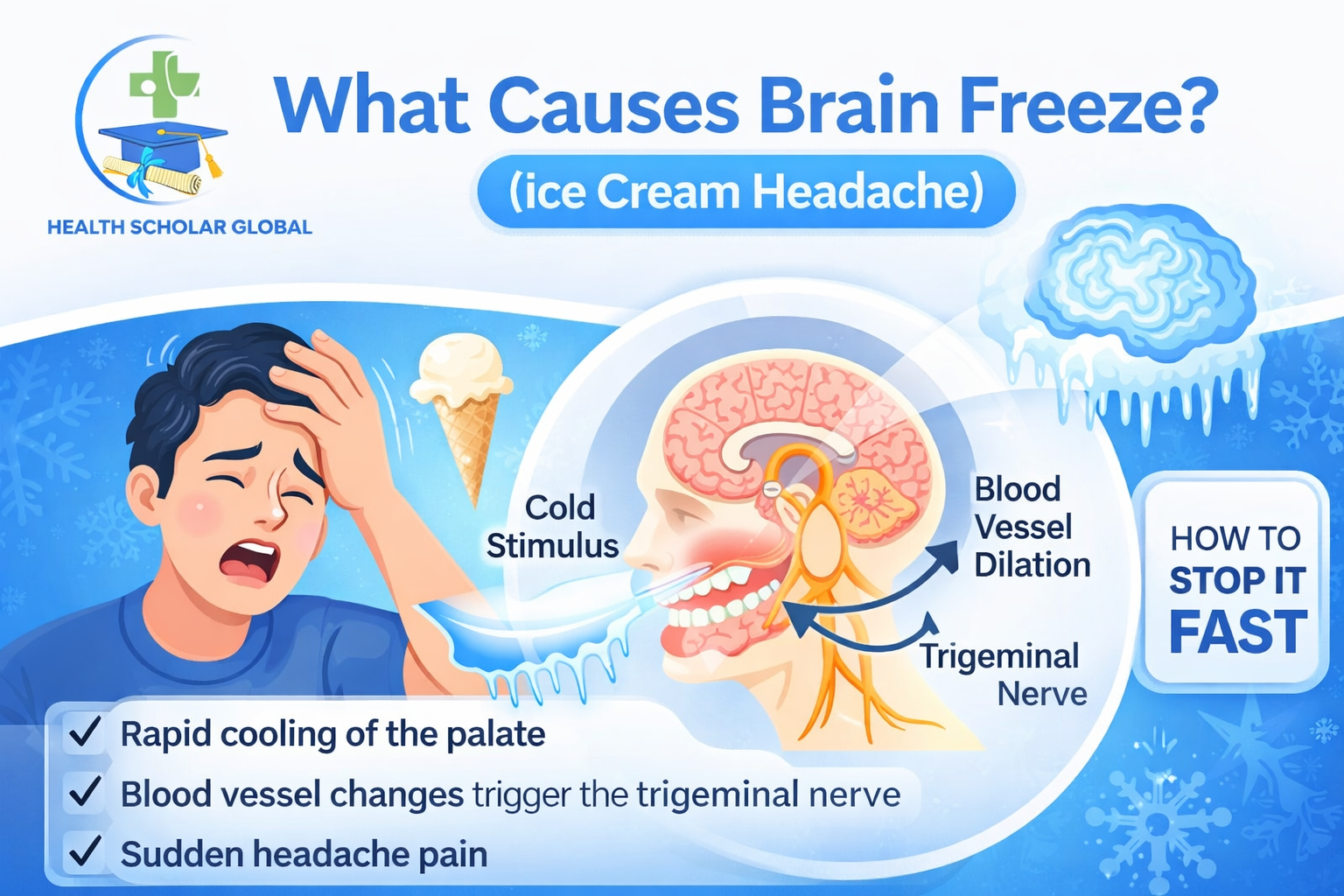
Brain freeze occurs due to rapid physiological responses triggered by cold exposure.
The process:
- Cold food or drink rapidly cools the palate (roof of the mouth)
- Blood vessels constrict (vasoconstriction)
- This is followed by rapid vasodilation
- Pain signals are transmitted through the trigeminal nerve
These rapid vascular changes activate pain receptors, leading to the characteristic headache.
Why Does Brain Freeze Hurt Your Head?
The pain is perceived in the forehead due to referred pain mechanisms.
The trigeminal nerve supplies both:
- The palate
- The forehead
Because of this shared neural pathway, the brain misinterprets the origin of pain, projecting it to the head instead of the mouth.
How to Stop Brain Freeze Quickly
You can relieve brain freeze almost immediately by restoring temperature balance.
Effective methods:
- Press your tongue against the roof of your mouth
- Drink warm fluids
- Slow breathing to stabilize blood flow
Why Do Some People Get Brain Freeze More Often?
Certain individuals are more susceptible due to:
- Migraine predisposition
- Faster consumption of cold foods
- Increased nerve sensitivity
Research indicates a strong association between brain freeze and migraine susceptibility.
Is Brain Freeze Dangerous?
Brain freeze is harmless and temporary, typically lasting less than a minute.
However, it shares mechanisms with other headache disorders, particularly migraines, involving:
- Rapid vascular changes
- Trigeminal nerve activation
How to Prevent Brain Freeze
- Eat cold foods slowly
- Avoid direct contact with the palate
- Take smaller bites
- Allow food to warm slightly before consumption
What Brain Freeze Reveals About the Brain
Brain freeze demonstrates:
- The sensitivity of cranial nerves
- The role of blood vessel dynamics in pain perception
- The brain’s rapid response to environmental changes
Frequently Asked Questions (FAQ)
What causes brain freeze?
Brain freeze is caused by rapid cooling of the palate, leading to vascular changes and trigeminal nerve activation.
How long does brain freeze last?
Usually between 10–60 seconds.
How do you stop brain freeze instantly?
Press your tongue to the roof of your mouth or drink something warm.
Can brain freeze be harmful?
No, it is harmless.
Why do I get brain freeze easily?
You may have increased nerve sensitivity or a migraine tendency.
Related : Try our quiz on Brain Freeze here
References
- Harvard Medical School. “What Causes Brain Freeze?”
- National Institutes of Health (NIH). Cold-Stimulus Headache Studies
- International Classification of Headache Disorders (ICHD-3). Cold-Stimulus Headache Definition
- Mayo Clinic. Headache Overview and Causes
- Hensel, H. (1973). Cutaneous Thermoreceptors and Sensation
- Serrador JM et al. (2012). Cold stimulus headache and vascular responses. FASEB Journal

Pingback: toradol safe duration
Pingback: ivermectin mechanism in demodex
Pingback: minoxidil explained
Pingback: minoxidil mechanism scientific overview
Kristina3344
July 1, 2026 at 10:48 amhttps://shorturl.fm/Kuvdm
Pingback: sildenafil safe sourcing