

 admin
admin 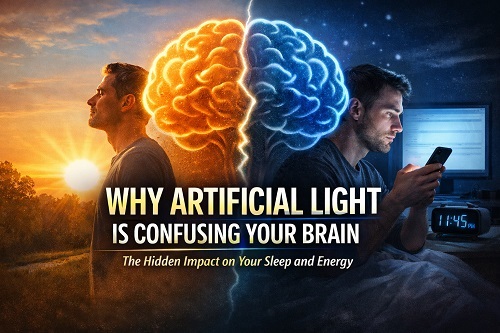
Artificial light may be silently disrupting your sleep, energy, and focus. Here’s how it affects your brain—and what you can do about it.
Introduction
Many people today believe they have a sleep problem. They go to bed on time, get a full night’s rest, and yet wake up feeling tired, unfocused, and slightly off throughout the day.
The immediate assumption is often that they need more sleep. However, in many cases, the issue is not the quantity of sleep, but the signals the brain is receiving.
One of the most overlooked factors affecting these signals is artificial light.
How the Brain Interprets Time
The human brain does not rely on clocks to regulate sleep and wake cycles. Instead, it depends on environmental cues—primarily light exposure.
This system, known as the circadian rhythm, helps the body determine when to be alert and when to rest. Natural light in the morning signals the brain to wake up and become active, while darkness in the evening triggers the release of melatonin, the hormone responsible for sleep.
Under natural conditions, this system functions efficiently. However, modern environments have significantly altered these signals.
The Role of Artificial Light
Artificial light, particularly from digital screens such as phones, laptops, and televisions, emits a high proportion of blue light. This type of light closely resembles daylight in terms of how the brain interprets it.
As a result, when individuals are exposed to bright screens or indoor lighting late into the evening, the brain receives a misleading signal that it is still daytime. This delays the release of melatonin and disrupts the body’s natural preparation for sleep.
Over time, this creates a mismatch between the body’s internal clock and actual sleep schedules.
Why This Leads to Fatigue
The effects of artificial light are not always immediately obvious, which is why many people overlook them.
Instead of causing dramatic sleep deprivation, artificial light tends to produce more subtle disruptions, such as:
- Difficulty falling asleep despite feeling tired
- Reduced sleep quality
- Frequent waking during the night
- Feeling unrefreshed in the morning
During the day, this can translate into:
- Low or unstable energy levels
- Reduced concentration
- Increased reliance on stimulants like caffeine
These symptoms often feel disconnected from their cause, making the underlying issue harder to identify.
The Modern Light Environment Problem
One of the main challenges is that modern life has removed the natural contrast between day and night.
Many people:
- Wake up and immediately look at their phones instead of natural light
- Spend most of the day indoors under artificial lighting
- Continue using screens late into the evening
From the brain’s perspective, the difference between morning, afternoon, and night becomes blurred.
This constant exposure to artificial light effectively confuses the brain’s timing system, making it difficult to regulate sleep and energy properly.
A Practical Shift: Restoring the Signal
Improving this situation does not require drastic lifestyle changes. Instead, the focus should be on restoring clear signals to the brain.
- Increase Morning Light Exposure
Getting natural light within the first hour of waking helps reinforce the body’s internal clock. Even a few minutes outdoors can make a noticeable difference.
- Reduce Light at Night
Dimming lights in the evening and limiting screen exposure before bed allows melatonin production to occur naturally.
- Create Contrast Between Day and Night
The key is not just reducing light, but creating a clear distinction:
- Bright during the day
- Dim and calm at night
This contrast helps the brain accurately interpret time.
Conclusion
Artificial light is not inherently harmful, but its constant and mistimed use can disrupt one of the body’s most fundamental systems.
For many people, persistent fatigue is not simply a result of poor sleep habits, but of a brain that is receiving mixed signals about when to be awake and when to rest.
By making small adjustments to light exposure, it is possible to restore this balance and improve both sleep quality and daytime energy.
📚 Sources
- Harvard Health Publishing. Blue light has a dark side
- National Sleep Foundation. Circadian rhythms and sleep
- Cajochen, C. (2007). Alerting effects of light. Sleep Medicine Reviews
- Chang, A.-M., et al. (2015). Evening use of light-emitting devices negatively affects sleep. PNAS
- Walker, M. (2017). Why We Sleep

Salim Rana
August 20, 2024 at 9:15 amI love the way the instructor goes about the course. So easy to follow, even though a
little bit challenging as expected.
Salim Rana
August 20, 2024 at 9:16 amThe way the instructor goes about the course. So easy to follow, even though a
little bit challenging as expected.
Salim Rana
August 26, 2024 at 5:56 amok